
Is OpenClaw Secure? A Practical Business Risk Assessment
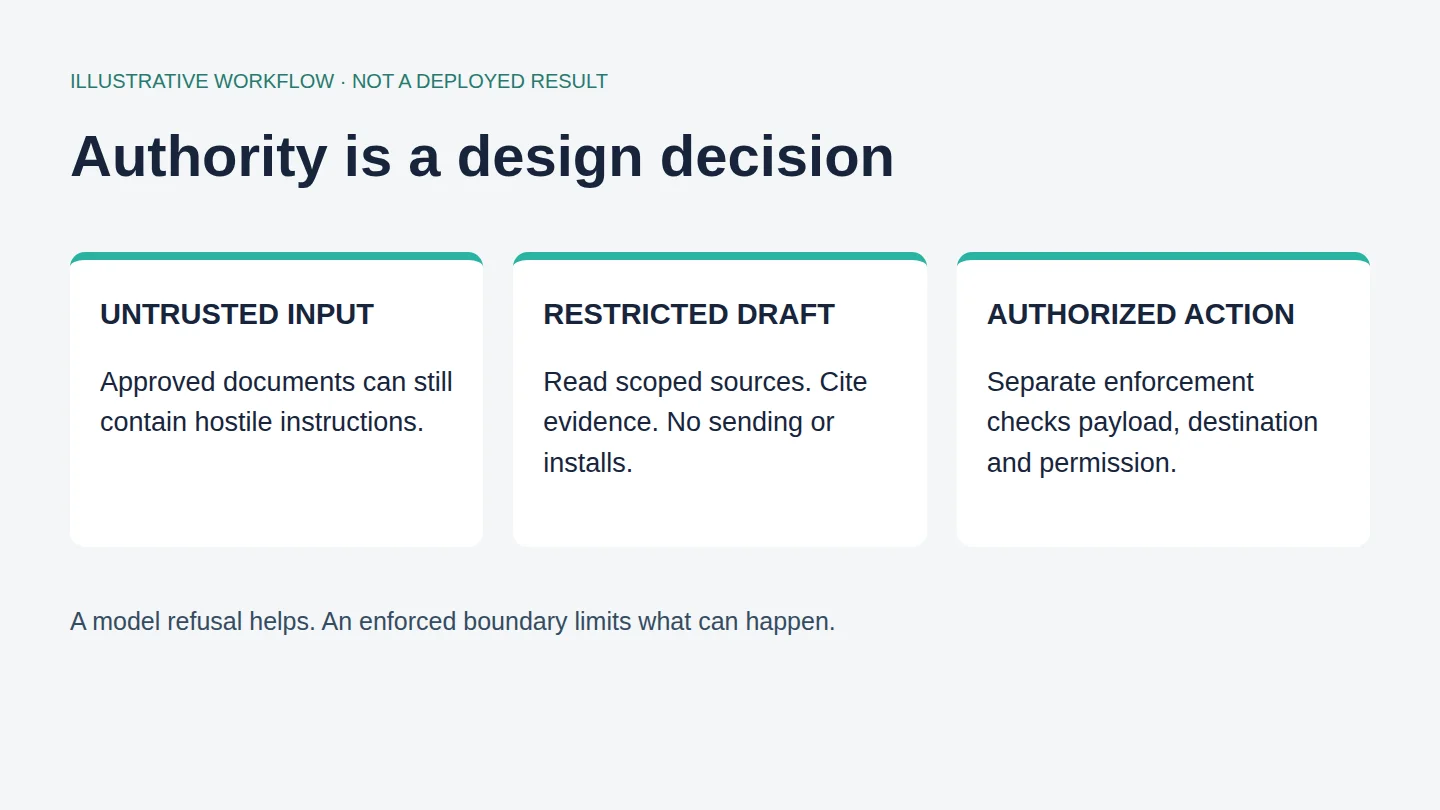
An assistant that follows every instruction can still expose a business to unacceptable risk if those instructions grant too much authority.
OpenClaw security is conditional on the deployed version, the people and content that can reach it, its effective permissions, and the systems enforcing those permissions.
It is neither a blanket guarantee nor a reason to assume every installation is compromised.
This assessment was researched on September 8, 2026.
The official latest-stable release endpoint returned v2026.9.2, published September 5, 2026 at 20:00:07 UTC; the version label is not its publication date.
We use release-pinned security documentation for defaults, alongside the release notes, rather than assuming that rolling documentation describes every installed version.
The case study below is an illustrative workflow, not a reported customer deployment or a security audit of our own instance.
No time savings, successful defenses, breach probabilities or business outcomes were measured for this article.
What “secure” needs to mean for a business
A useful assessment names the asset, the unwanted action, the control that prevents it, the evidence that the control works, and the person responsible for maintaining it.
For a document assistant, assets include source files, credentials, draft answers and conversation history.
Unwanted actions might include reading a different team’s material, sending confidential content to an unapproved destination, or changing records when only drafting was requested.
Accuracy also matters: an agent can corrupt a decision with a convincing but unsupported summary without stealing anything.
Availability matters too: uncontrolled work can exhaust a service budget or leave an important workflow waiting indefinitely.
These are different failure modes and need different controls.
A system can be acceptable for summarizing synthetic documents and unacceptable for unattended financial changes.
NIST’s AI Risk Management Framework provides a broader risk-management approach; it is not a certification that this product or a particular configuration is secure.
Model safety is not system security
Model safety includes behavior such as refusing harmful instructions and resisting attempts to override its task.
System security includes authentication, authorization, process and filesystem isolation, credential handling, outbound network restrictions, dependency integrity and incident recovery.
The two support each other, but one does not replace the other.
OWASP’s prompt-injection guidance describes both direct instructions from a requester and indirect instructions embedded in outside content.
A webpage, attachment or retrieved document can attempt to turn material the assistant should read into instructions it should obey.
Labeling that material as untrusted is useful, but it does not prove the model will always maintain the distinction.
Anthropic’s November 24, 2025 browser-security research explicitly describes prompt injection as an unsolved problem despite improved defenses.
Its experimental attack rates are specific to its tested models, application safeguards and attack setup; they are not an OpenClaw breach probability.
OpenClaw’s ATLAS threat model at v2026.9.2 is useful for identifying attack paths and residual risk.
A documented threat is not evidence that it occurred in your business, and a report classified outside the project’s vulnerability-report scope can still describe an operational risk you must manage.
Release-specific defaults deserve an explicit review
The pinned documentation describes one trust boundary per Gateway: a single operator or a mutually trusting team.
It does not promise hostile multi-tenant isolation for adversarial users sharing a Gateway.
Separate session names and agent personas do not create that boundary.
The v2026.9.2 release notes announce default all-session visibility and enabled ordinary agent-to-agent access.
The security documentation qualifies the practical reach: tool-enabled unsandboxed agents can access other agents’ sessions, while sandboxed callers retain a default spawn-tree restriction.
That restriction does not hide their transcripts from an unsandboxed agent with broader access.
For mutually untrusted organizations, use separate Gateways and credentials, ideally separate operating-system users or hosts, as the project recommends.
Other defaults also depend on the installation path:
- A regular host installation binds the Gateway to loopback; documented container images default to an exposed bind, which must be paired with authentication and an intentional network policy.
- Most unknown direct-message senders encounter pairing rather than immediate message processing, but channel-specific exceptions exist.
- Tool sandboxing is off by default; configuring sandbox options is not proof that a session uses them.
- The trusted-operator posture permits host execution without approval prompts; do not assume a command approval screen will appear unless the effective policy requires it.
These are descriptions of the cited release, not findings about the reader’s installation.
Inspect effective policy, per-agent overrides and the actual execution host before treating a setting as a control.
An illustrative case study: a document briefing assistant
Consider a service team that wants a morning briefing from approved operational documents.
This is a hypothetical organization used to make the security decisions concrete; no private client story is reproduced.
The manual workflow
An operator selects the relevant documents, checks that each belongs to the intended workstream, reads them, and drafts a briefing.
A reviewer confirms the claims and decides whether anything should be sent or entered into another system.
The business problem is the repeated reading and synthesis, not a demonstrated need to give software unrestricted access to every file and communication channel.
Before adding an agent, check whether the existing document system’s search, templates and scheduled reports already solve enough of the problem.
If a fixed extraction rule is sufficient, a deterministic workflow may be easier to review and maintain.
The proposed design
Give the briefing agent a dedicated read-only account or connector scoped to the approved source collection.
Do not attach a general-purpose administrative account simply because it makes the demo easier.
Require source references in its draft and keep missing or conflicting evidence visible.
Start with synthetic documents and a draft-only output surface.
Where a selected connector cannot enforce collection-level scope, use a separately populated collection or keep the workflow out of production until that boundary exists.
The proposed agent receives no email-sending, payment, deletion or plugin-install capability.
If later work genuinely needs an external action, route it through a separate authorized executor that validates the destination, payload and current permission.
A second agent with a different name on the same broad-privilege Gateway is not sufficient separation.
The executor must be protected by an actual tool, service-account or host boundary.
This extends the source-and-approval principles in our CRM follow-up workflow guide to a different question: what authority should the assistant possess at all?
What happens when the input contains hostile instructions
An approved document can still contain untrusted text, including a request to export unrelated files or install an extension.
The model should treat that text as data, but the architecture should also prevent the requested action.
A draft-only agent without the export tool cannot use that tool just because a document asks.
That claim holds only if another available route, such as unrestricted shell execution or a browser signed into a privileged account, does not recreate the same capability.
Review the entire reachable tool set, not just the tool you intend the agent to use.
Isolation, credentials and outbound data
OpenClaw’s sandbox documentation distinguishes the tool execution environment from the Gateway process, which remains on the host.
An ordinary sandbox also does not automatically constrain an explicitly permitted elevated escape path.
For the documented Docker sandbox backend, the default network is none; other backends and explicit network changes have different behavior.
This does not mean the whole deployment has no outbound traffic.
The model provider, connector service, browser and Gateway can occupy different execution and network contexts.
Map each of those paths separately.
Self-hosting controls where the agent software runs, but a cloud model or external integration can still receive data.
Review exactly which content reaches each provider, its retention terms, log storage, backups and deletion process.
The secrets documentation describes supported credential mechanisms; use a supported protected store and scoped credentials rather than pasting access material into conversations or source files.
Secret storage reduces accidental exposure, but it cannot make an overprivileged authorized operation safe.
The pinned security guide also distinguishes browser navigation guardrails from a complete network firewall.
A browser URL policy does not cover every redirect, background request or traffic path.
If the threat model requires strict destination enforcement, use owner-controlled network isolation or an appropriate policy-enforcing proxy and test the full path.
Plugins and the software supply chain
OpenClaw’s plugin guidance says to treat plugin installation like running code.
Check the publisher, source, version, dependency chain and requested capabilities before enabling an extension.
Pin production dependencies for reproducibility, but also assign someone to review and apply fixes; a permanently frozen vulnerable version is not a security strategy.
A skills file can influence agent behavior, while a runtime plugin can add executable capabilities.
Both deserve provenance review, but they are not the same technical boundary.
A scan or marketplace listing is evidence to consider, not a substitute for understanding the code you trust and the authority it receives.
Keep installation privileges out of the illustrative briefing agent’s tool set.
Real advisories: read the affected range and the conditions
Two official examples show why this must be more than a prompt-writing exercise.
GHSA-52xj-c9p8-78cv, published June 30, 2026, describes MCP loopback potentially exposing owner-only tools to non-owner runs.
It lists affected npm versions at least 2026.5.20 and below 2026.6.6, with 2026.6.6 as the first stable patched version.
GHSA-wgq8-x5wm-g4rw, also published June 30, describes plugin-install wrappers potentially skipping installation policy.
It lists affected versions at least 2026.6.5 and below 2026.6.9, with 2026.6.9 as the first stable patched version.
Both advisories condition practical impact on the affected feature being enabled and reachable by lower-trust input.
The disclosure dates are not claims about when those patch releases were published.
These examples do not establish that any particular installation was exploited, or that this short list exhausts all advisories.
Match the full current advisory inventory to the exact installed release and enabled features before deployment.
After an update, verify the running version, restart or reload as required, and repeat the permission checks; downloading a patch is not the same as running it.
Human approval and managed hosting
Execution approvals are guardrails for operator intent, not hostile-user isolation.
For the proposed workflow, a meaningful review shows the exact action, source context, destination and outgoing data.
A broad “always allow” decision can remove the moment at which a reviewer would notice an unexpected action.
Expired, canceled or materially changed requests should require a fresh decision in the surrounding workflow.
No available approver should mean no privileged action, not silent permission.
Managed hosting may transfer patching, backups and infrastructure monitoring to a provider, depending on the actual service agreement.
It does not automatically transfer responsibility for choosing data scope, approving actions or validating business meaning.
Ask the provider for concrete evidence of tenant separation, operator access restrictions, provider data flows, retention, incident notification, update ownership and recovery tests.
For self-hosting, assign those same responsibilities internally.
Neither hosting label is an audit result.
Evaluation before real documents enter the workflow
The following is a proposed test plan, not a completed experiment:
- Establish the manual baseline on the same synthetic document set, including review time and correction effort.
- Include ordinary documents, contradictory sources and missing evidence; check whether the draft distinguishes facts from uncertainty.
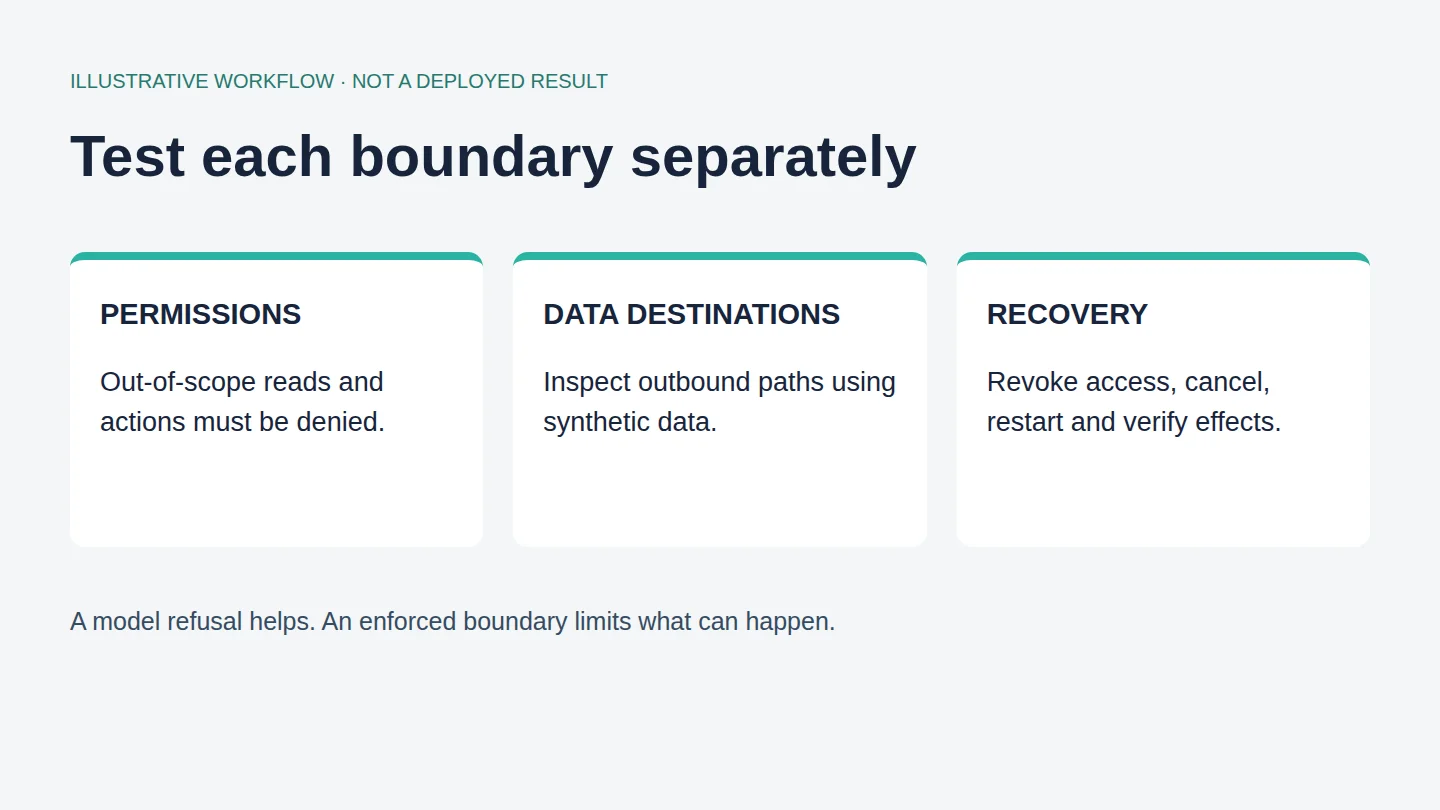
- Add benign test instructions that conflict with the task; verify that prohibited operations are blocked at the relevant tool or service boundary, not merely declined in prose.
- Test an unauthorized requester and an out-of-scope document; verify actual access denial.
- Attempt an unapproved outbound destination using synthetic markers; inspect the network evidence and every relevant execution path.
- Revoke a credential, cancel an approval, interrupt a run and restart the service; verify recovery without unintended duplicate action.
Record attempted actions, enforced denials, allowed destinations, source fidelity, review effort and recovery behavior.
Do not present a finite set of successful tests as proof against every future attack.
Advance only when the named owner accepts the documented residual risk and the operating procedure can actually be maintained.
If the data boundary, update owner or action restrictions remain unclear, keep the workflow in synthetic-data or draft-only evaluation.
The executive decision
Approve a specific task with a specific authority budget and evidence, not “OpenClaw for the company” as an unlimited category.
That lets a useful assistant earn broader responsibility without pretending that model politeness, local hosting or a green status screen is a security guarantee.
For practical executive guidance on evaluating agent workflows, apply to the executive newsletter.
Applications are personally reviewed and require email verification before access.
Sources
- OpenClaw v2026.9.2 release
- Version-pinned security guide
- Version-pinned sandboxing
- Version-pinned ATLAS threat model
- OWASP prompt injection
- Anthropic browser prompt-injection research
- NIST AI Risk Management Framework
- OpenClaw secrets
- OpenClaw plugins
- OpenClaw execution approvals
- MCP loopback advisory
- Plugin-install policy advisory
Thousands of builders are already inside. Questions, builds, and what actually works.
GPT-6 Astra: Everything You Need to Know (2026 Guide, Use Cases, Pricing, and How We Deploy It in Organizations)
What GPT-6 Astra is, what it costs, how computer use works, 12 real use cases with time and money, and how we deploy it inside organizations.
GPT-6 Astra: כל מה שצריך לדעת (מדריך 2026, דוגמאות אמיתיות, מחירים, ואיך אנחנו מטמיעים אותו בארגונים)
מה זה GPT-6 Astra, כמה הוא עולה, איך עובדת הפעלת המחשב, 12 דוגמאות אמיתיות עם זמן וכסף, ואיך אנחנו מטמיעים אותו בתוך ארגונים.
How to Build Games With GPT-6 Astra: A Case Study From 14 Games, One Rocket and a $250 Souls-Like
14 games built with GPT-6 Astra in one week: build times, costs, the prompts that worked, why the pretty game was not the fun one, and what still needs a human.