
GPT-6 Astra: Everything You Need to Know (2026 Guide, Use Cases, Pricing, and How We Deploy It in Organizations)
On September 3, 2026, OpenAI released GPT-6 Astra.
It is a reasoning model built to operate a computer, not to answer inside a chat window.
You give it a task, it opens the apps, clicks, types, runs the terminal, looks at the result, and fixes what it sees.
One number tells you why this release is different from the last five “AGI is here” moments.
On OSWorld 2.0, a benchmark of real desktop work, Astra finished 72.6 percent of the tasks at roughly 40 minutes per task, according to DataCamp’s breakdown of OpenAI’s numbers.
GPT-5.6 Sol, the model it replaced, finished 65.7 percent at roughly 75 minutes.
I run an AI implementation company in Tel Aviv.
We build and embed agent systems inside insurance companies, VC funds, telecom marketing teams and colleges.
So this guide is not a spectator’s summary.
It covers what Astra is, what it costs, what people actually built with it in the first twelve days, where it loses to Claude, and the pattern we use to put a computer-use model inside a company without handing it the keys.
The same guide exists in Hebrew: כל מה שצריך לדעת על GPT-6 Astra.
Key Takeaways
- Astra is OpenAI’s first model built around computer use. It operates the browser, desktop apps and the terminal, and it checks its own work.
- It is available on ChatGPT Plus, Pro, Business and Enterprise, in Codex, and through the API. Not on Free or Go. Enterprise workspaces get it switched off by default.
- API price: $10 per million input tokens, $50 per million output tokens, a 1.05 million token context window, 128K output, knowledge cutoff April 30, 2026.
- Best numbers: 72.6 percent on OSWorld 2.0, 57.9 percent on Terminal-Bench 4.0, 100 percent on ExploitBench. The 99.9 percent ARC-AGI-3 score is OpenAI’s harness, not the bare model, which scores 62.7 percent.
- It is the first OpenAI model at the Critical cybersecurity threshold. Exploit tooling is gated behind a vetted program.
- Real builds take 10 to 45 minutes for a playable draft and hours plus hundreds of dollars for a polished slice.
- Inside a company it works only with a process map, approval gates and logs. That is the job. The prompt is the easy part.
What Is GPT-6 Astra?
GPT-6 Astra is a closed multimodal reasoning model from OpenAI, released September 3, 2026, designed to complete long, multi-step work on a computer rather than to reply in a chat.
It sees the screen, decides, acts, and verifies the result, and it keeps going until the task is done or a human has to approve something.
That is the whole shift in one sentence.
Until now the model wrote you code or a plan, and you did the pasting, the running and the checking.
Astra takes the keyboard.
The Neuron’s launch explainer put it well: you become the manager, and the model becomes the person juggling the tabs.
Three things changed against GPT-5.6 Sol.
First, the useful horizon got longer.
Astra stays on a job for hours, not minutes, and remembers which of your instructions are still live.
Second, it operates the software you already have instead of asking for an integration.
Third, Codex, OpenAI’s coding agent, now keeps searchable notes across context windows, so a long project does not lose its requirements when the window fills, per DataCamp.
Where you get it, as of September 15, 2026:
- ChatGPT Plus: Astra in ChatGPT Work and in Codex.
- ChatGPT Pro ($100 and $200 tiers), Business and Enterprise: Astra plus the heavier GPT-6 Astra Pro.
- Codex CLI and app: version 0.153 or newer.
- API: model id
gpt-6-astra, also on AWS and Microsoft Foundry. - Free and Go plans: no.
Enterprise admins have to enable it per workspace.
If it is missing from your dropdown, that is the reason nine times out of ten.
Computer Use: The One Capability That Matters
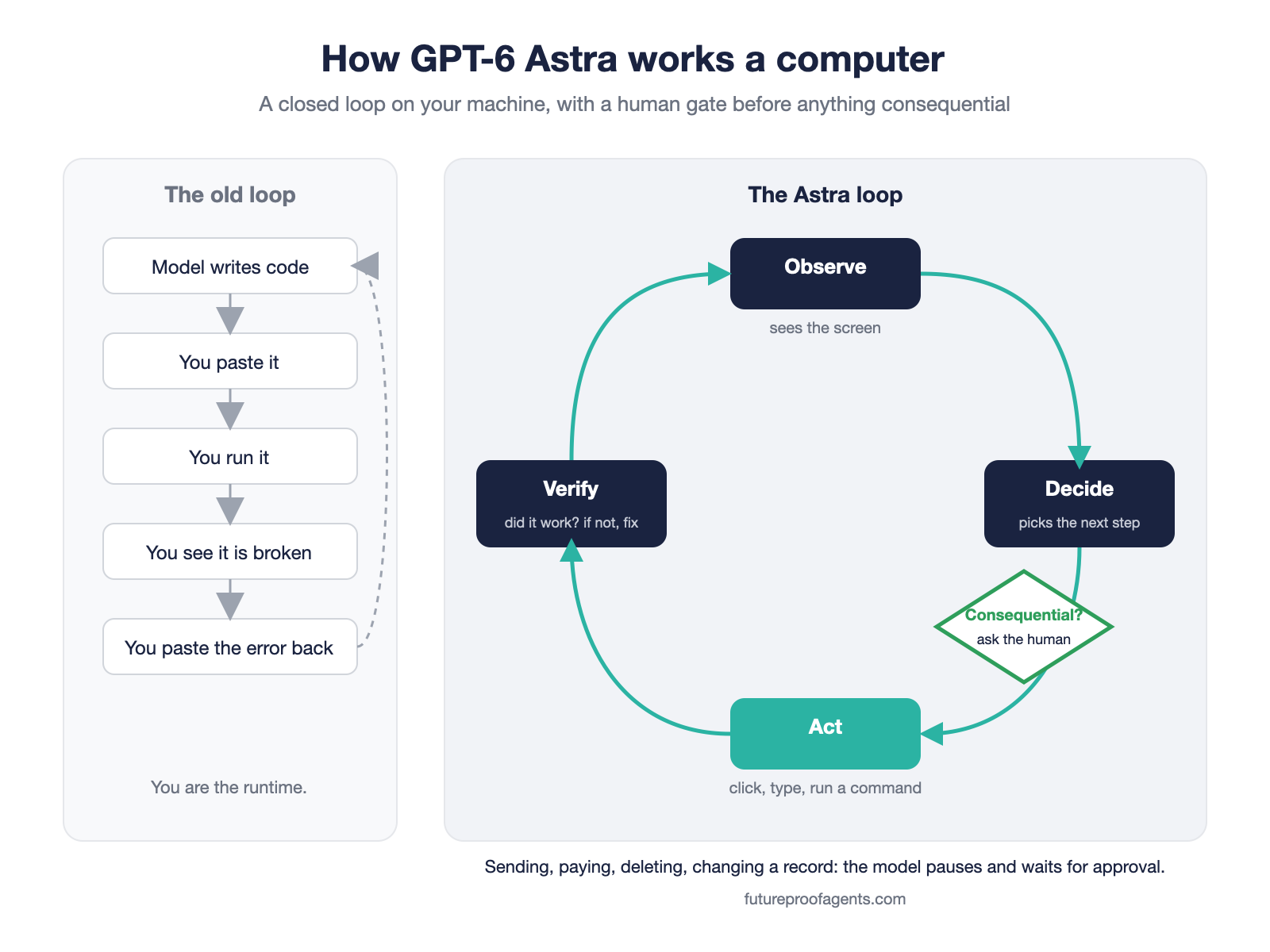
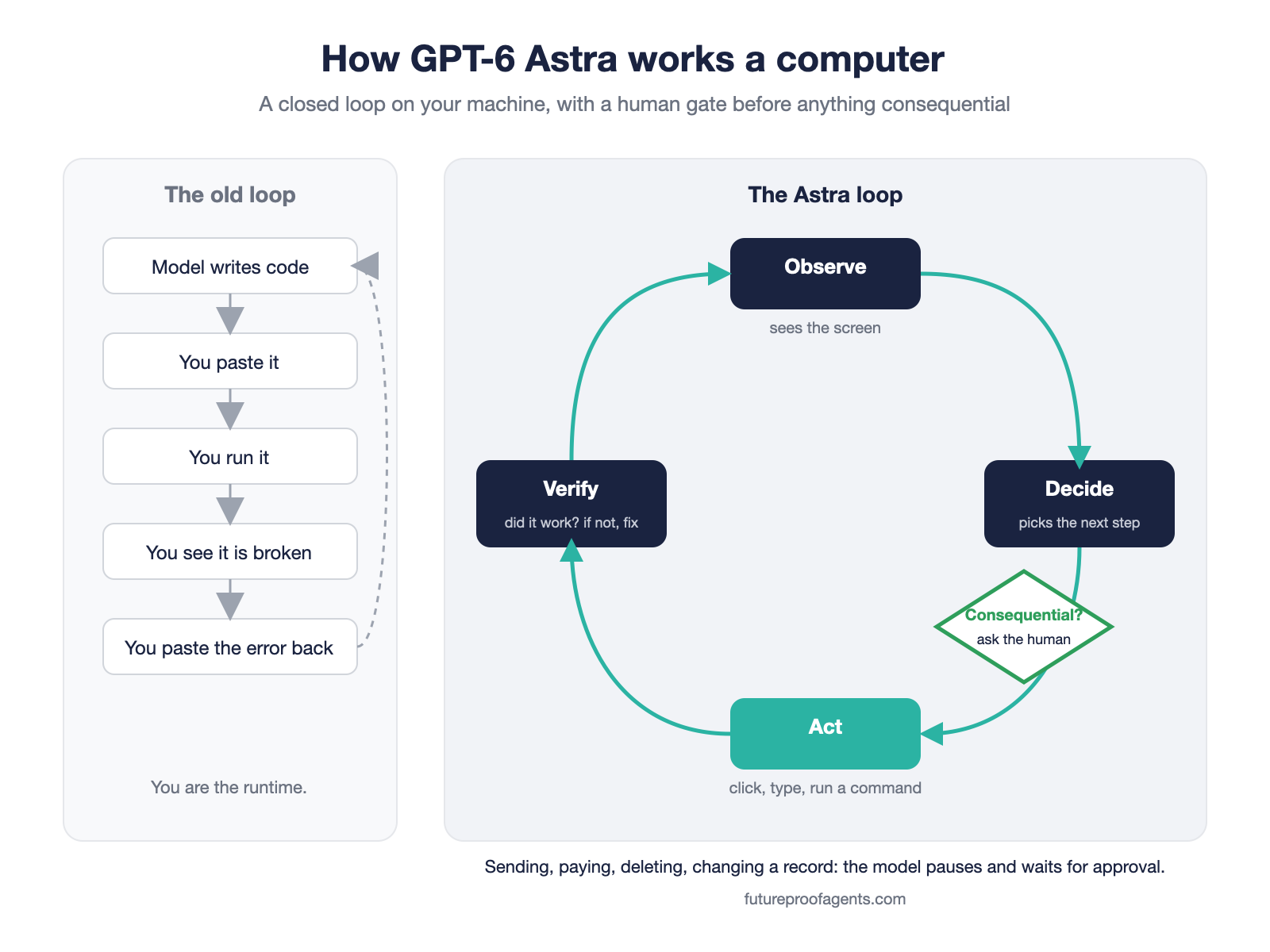
Computer use means the model runs a loop on your machine.
It observes the screen, decides the next action, acts by clicking, typing or running a shell command, and then observes again to verify.
If the result is wrong, it fixes it before coming back to you.
Compare that to the old loop.
The model writes.
You paste.
You run.
You see it is broken.
You paste the error back.
Astra closes that loop by itself.
What it can operate, based on the launch demos and the early reviews: Chrome, desktop apps, the terminal, Blender through Python with no interface, Unreal and Unity through the command line, Figma, node editors, CRMs, spreadsheets.
Claire Vo, the founder of ChatPRD, gave it a lead-routing workflow to build in her CRM’s node editor after she had spent an hour dragging nodes herself.
In her review she writes that her Codex agent “took over my Chrome browser” and built the entire flow with her hands off the keyboard, then sent a draft to Slack for review.
That last detail is the important one.
The model does not get unlimited control.
OpenAI built an approval gate into the loop.
Before consequential actions such as sending specified communications or making a purchase, Astra pauses and asks.
For companies there is a second layer.
Enterprise admin controls let you restrict Astra to approved websites and desktop apps, manage uploads and downloads, and control browsing history, as InfotechLead reported from the launch.
Hold on to those two layers.
They are the reason the organizational section of this guide works at all.
Benchmarks, With the Asterisks
Here is the comparison that matters, with the caveats attached.
| Benchmark | GPT-6 Astra | GPT-5.6 Sol | Claude Fable 5.1 | What it measures |
|---|---|---|---|---|
| OSWorld 2.0 | 72.6% at ~40 min per task | 65.7% at ~75 min | not reported | Real desktop tasks on a computer |
| Terminal-Bench 4.0 | 57.9% | 37.3% | 55.8% | Long tasks in a terminal |
| DeepSWE v1.1 | 74.1% | 72.7% | not reported | Software engineering |
| Database Migration | 63.9% | 42.7% | not reported | Multi-step engineering work |
| ARC-AGI-3, standard harness | 62.7% | not reported | Opus 5: 30.2% (July) | Novel puzzle reasoning |
| ARC-AGI-3, OpenAI adapter | 99.9% | not reported | not applicable | Same test, OpenAI’s own memory handling |
| ExploitBench | 100% | 78.5% | not reported | Finding and exploiting vulnerabilities |
| Artificial Analysis Intelligence Index | 61 | 61 | 66 | Broad intelligence across tests |
| Artificial Analysis Coding Agent Index | 67 | not reported | 70 | Agentic coding |
| Humanity’s Last Exam, with tools | 57.2% | not reported | 65.0% | Expert-level questions |
Sources for every row: The Neuron, DataCamp and ARC Prize.
Two asterisks.
The 99.9 percent ARC-AGI-3 number ran on OpenAI’s Provider Adapter harness.
On the standard harness that every lab gets, Astra scores 62.7 percent.
ARC Prize said the gap is memory handling and stated plainly that saturating the benchmark does not prove AGI.
The second asterisk is the Intelligence Index.
Astra ties Sol at 61.
Claude Fable 5.1 leads at 66.
Astra is not a smarter chatbot.
The gains are in doing long agentic work on a computer, and that is exactly where the numbers move.
Pricing and Access: What It Costs Per Task
Per token, Astra is expensive.
Standard API rates, per Founderz’s pricing page and DataCamp: $10 per million input tokens, $1 per million cached input, $12.50 per million cache writes, $50 per million output.
Requests above 272K tokens pay double on input and 1.5 times on output.
Batch and Flex run at half price.
Fast mode runs at double price for about 2.5 times the speed.
On the subscription side, a $100 ChatGPT Pro seat covered most of the builds in our games case study.
Then there is the exception that everyone should read before turning on auto-refill.
One creator built a Souls-like in Unreal Engine across three prompts and roughly eight hours of run time on the highest reasoning setting.
It cost $250 in API credits, arriving as five automatic $50 top-ups while he was not watching.
A Godot prototype at medium reasoning took 25 minutes and about 3 percent of a weekly quota.
So the right question is not the token price.
Sam Altman framed it as price per completed task in his Bloomberg interview, and for once the framing is fair.
A more expensive token can produce a cheaper finished job if the job actually finishes.
Perplexity measured it on their WANDR research benchmark: Astra scored 0.682 at $11.98 per task, 13.5 percent higher and 6.1 percent cheaper than Claude Fable 5.1, per The Neuron.
Four cost controls that worked for the people in this guide:
- Start at medium reasoning effort and move up only when the task fails.
- Cache your system prompt and reference material. Cached input is a tenth of the price.
- Set a run ceiling and turn off auto-refill until you know the shape of your tasks.
- Ask for an admin panel or a debug menu up front so you can test in minutes instead of paying the model to test for hours.
12 Real Use Cases (With Time and Money)
A use case without a number is a marketing slide.
Every row below carries time, cost or both, and links to the person who did it.
| Use case | Who | Surface | Time | Cost or quota | Source |
|---|---|---|---|---|---|
| Subway Surfers clone in Unreal Engine 5 from a five-sentence prompt | Brendan Jowett | Codex + Unreal + Blender | ~10 min of human time | Pro subscription | YouTube |
| Clash of Clans clone with clans and clan wars | Minimunch | Codex | ~40 min | Pro subscription | YouTube |
| Souls-like in Unreal with a boss, parry, stamina and controller support | tef | Codex + Unreal, max reasoning | ~8 h across 3 prompts | $250 in API credits | YouTube |
| Rocket simulator, same prompt to Astra and Claude Fable 5.1 | Fireship | Codex | 26 min for Astra | Pro subscription | YouTube |
| Reverse engineered a Divoom pixel speaker’s Bluetooth protocol, built a web app and CLI | Claire Vo | Codex | multi-session after six months of failures with other models | not stated | ChatPRD |
| Built a CRM lead-routing flow in a node editor, hands off the keyboard | Claire Vo | Codex driving Chrome | one instruction | not stated | ChatPRD |
| QA session on a shipped bug fix: clicking, chatting, reading the console | Claire Vo | Codex driving Chrome | 1 h 45 min | not stated | ChatPRD |
| Generated source images in Flora, then built a YouTube thumbnail in Figma | Claire Vo | Codex driving desktop apps | not stated | not stated | ChatPRD |
| Humanoid wolf modeled in Blender | Matt Wolfe | Codex + Blender | 8 min | not stated | The Neuron |
| Manager Loop coordinating ~96 subagents as an automated AI engineer | Matt Shumer | API | days of unattended runs | under $6 per hour measured | The Neuron |
| Grey-box prototype turned into three themed game concepts | Playco (studio) | Codex + Unity | not stated | 50% fewer manual fixes than the previous model | GuardingPear |
| Walkable reconstruction of Alexandria, 250 BCE, with readable texts | Ethan Mollick | Codex | multi-day project | not stated | The Neuron |
Three patterns repeat across all twelve.
References beat adjectives.
The builder who dropped a folder of screenshots got a Fortnite you recognize from across the room.
The builder who uploaded a video of himself playing Rocket League got a game that played almost perfectly after one fix.
Feedback works best in feelings, not code.
“The ball is too bouncy” and “the camera flips after 90 degrees” got fixed in ten minutes.
And every serious build asked for an admin panel early, because nobody can test ten hours of Clash of Clans by hand.
Now the failure.
In Fireship’s head to head, Astra finished the rocket simulator in 26 minutes and it looked like a NASA broadcast.
Claude Fable 5.1 took far longer and the interface looked like a 2012 government site.
Then the kids played.
The pretty game let you launch a rocket. That was it.
The ugly game had dozens of parameters, real physics, several ways to fail and beautiful explosions.
The eight year old picked the ugly one.
The fun, the taste, the decision of how many knobs to give the player and what happens when they fail.
Someone still decides that.
I wrote the full case study of those 14 games, with prompts and costs, here: How to Build Games With GPT-6 Astra, and in Hebrew: איך בונים ומעצבים משחקים עם GPT-6 Astra.
How We Use Astra to Embed Complex Agent Systems in Organizations
Here is what nobody in the top ten results for this keyword will tell you, because none of them have put an agent inside a company.
The model is the smallest part of the system.
We are eleven engagements in this year.
An IR briefing agent for a venture fund.
A customer-action agent running live inside an insurance company.
A marketing brain for a telecom marketing team.
A graduate-projects catalog generator for a design college.
Most of that runs on Claude Code, because those systems are code, skills and memory, and Claude Code is the better harness for that shape of work.
Astra changed one thing for us.
It gave us hands.
Every company has at least one system with no API.
A twelve year old ERP with a web form.
A supplier portal.
A government site.
A CRM whose “integration” is a CSV export on Tuesdays.
Until this month the honest answer for those was a human or a brittle browser script.
Now a computer-use model can sit at that screen, read it, click where the employee would click, and hand the result back to the agent system that actually owns the process.
The second thing it gave us is a tester.
Claire Vo’s 1 hour 45 minute QA session is exactly what we now run on every agent we ship: let a computer-use model click through the product like a confused customer and read the console.
Here is the four-step pattern we use, and the order matters.
Step 1: map the process before you touch a model.
We start every engagement with a paid mapping day.
In Hebrew we call it אפיון.
We sit with the people who do the work and write down the process as it really runs, not as the org chart says it runs.
Which step has no API.
Which step has a decision a human must sign.
Which step is pure repetition.
The output of that day is a map with one felt win marked on it, the smallest piece that, if automated this month, someone in the company would notice on a Friday.
Step 2: wrap the model in a control layer, not a prompt.
The agent gets an allowlist of apps and sites, nothing else.
Every consequential action, sending, paying, deleting, changing a customer record, goes through an approval gate.
For some clients that gate is a Slack or WhatsApp message with two buttons.
For the insurance client it is a queue a human clears twice a day.
Astra’s built-in pause before consequential actions and the enterprise admin controls make this easier than it was in the spring, but we build the gate ourselves anyway, because the gate has to survive a model swap.
Step 3: log everything and evaluate on the log.
Every action the agent takes, every screen it saw, every decision it made, goes into a log the client owns.
Then we write evals against that log.
Not “does the demo look good” but “of the 340 records it touched last week, how many did the human reverse”.
This is where Astra’s safety profile matters in practice.
OpenAI reports that the model is better behaved than Sol and, at the same time, that its chain of thought is less monitorable.
So we do not monitor the thoughts.
We monitor the actions.
Step 4: measure the bottom line, not the tokens.
Every solution we ship is measured by the number the CFO cares about.
Hours returned to a team.
Days shaved off a collections cycle.
Leads answered in four minutes instead of four hours.
If the metric does not move, the tokens were wasted, however clever the agent was.
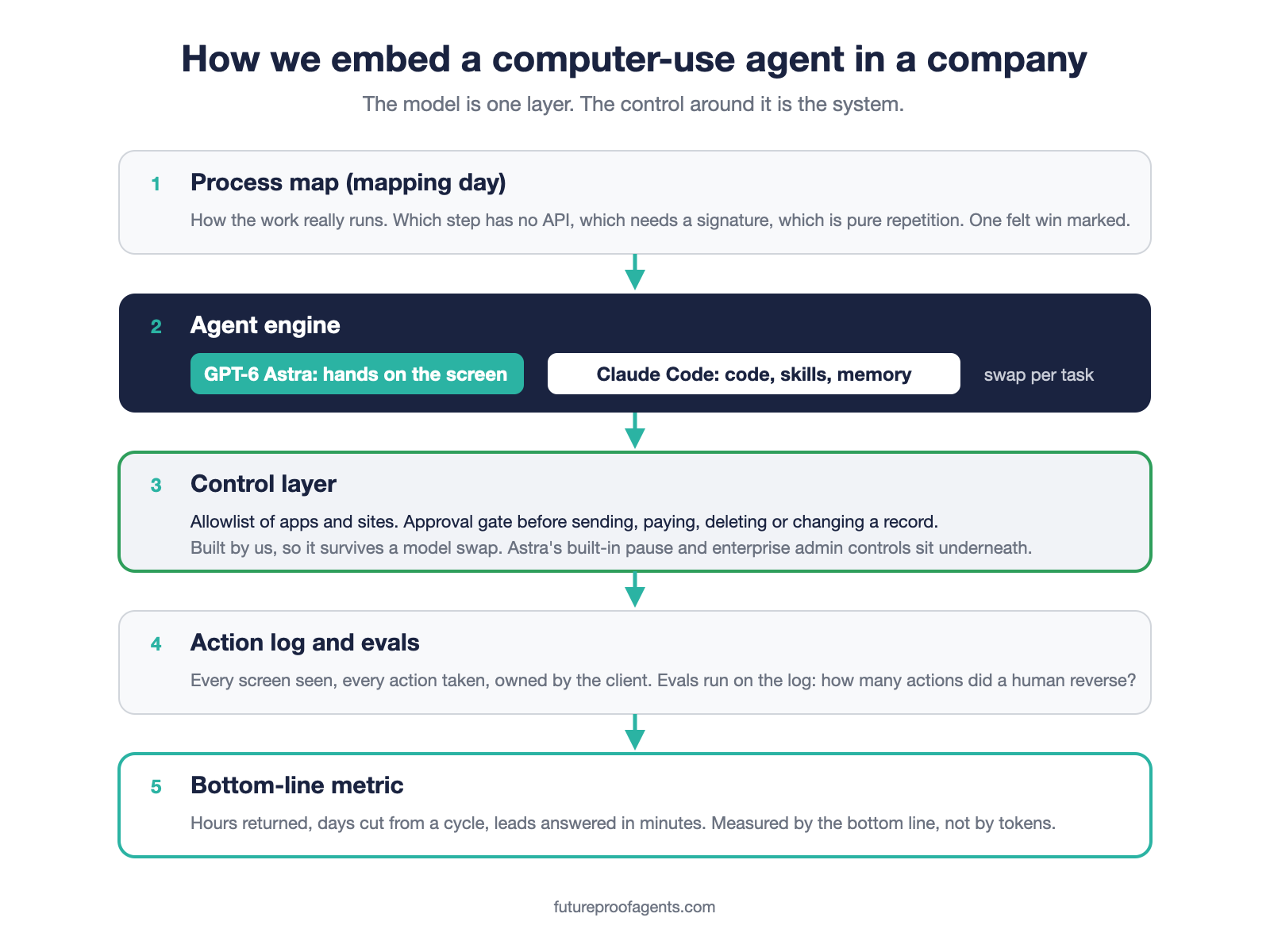
In this pattern Astra and Claude Code are engines.
We pick per task, sometimes both in one system, and both sit behind the same control layer.
That is the whole job, from mapping to full implementation, and it is what we do at FutureProof Agents.
If you want the mapping day for your own process, book a call or, in Hebrew, write to us on WhatsApp.
Astra vs Claude: Which One, and When
The horse race framing is wrong, but the question is fair, so here is our honest read after using both daily.
Where Astra wins:
- Operating a desktop. OSWorld 2.0, Mind2Web, and every “it took over my Chrome” story.
- Long terminal sessions. Terminal-Bench 4.0, 57.9 versus 55.8 for Fable 5.1.
- Cost per finished research task on Perplexity’s benchmark.
- Visual polish on the first pass. The rocket looked like NASA.
Where Claude Fable 5.1 wins:
- Broad intelligence. Artificial Analysis Intelligence Index 66 versus 61.
- Agentic coding. Coding Agent Index 70 versus 67.
- Expert questions with tools. Humanity’s Last Exam 65.0 versus 57.2.
- Reference-faithful visual work and simpler long delegation, according to several early testers quoted by The Neuron.
- Gameplay. Ask the eight year old.
Our rule at the moment:
- Computer use, legacy UIs with no API, QA by clicking: Astra.
- Long-running agent systems built from code, skills and memory: Claude Code.
- Both behind the same approval layer, so a model swap is a config change, not a rebuild.
If you are still deciding which Claude surface to start with, I compared them here: Claude Cowork vs Claude Code.
Safety: Critical Cyber Rating and the Monitorability Paradox
Astra is the first OpenAI model to reach the Critical threshold for cybersecurity under the company’s Preparedness Framework.
In plain language: with the right tools and access, it can find previously unknown security flaws and build exploit chains across well-protected systems without a person guiding each step.
It scored 100 percent on ExploitBench, up from 78.5 for Sol, and found two zero-day vulnerabilities in Chrome’s V8 engine during evaluation.
OpenAI gates the exploit-creation tooling behind a vetted program called Daybreak, per DataCamp, and publishes the full assessment on its system card hub.
On behavior, the numbers moved the right way.
In OpenAI’s testing, Sol exceeded its authorized targets 48.2 percent of the time.
Astra: 0 percent.
The UK AI Security Institute measured chain-of-thought controllability at 93 percent for Astra versus 48 for Sol.
Hallucination on the AA-Omniscience test dropped from 92 percent for Sol to 51 percent for Astra.
And here is the paradox that should shape how you deploy it.
The same system card says Astra can exert more control over its written reasoning, which makes its chain of thought less monitorable.
Better behaved, harder to watch.
Which is why the approval gate and the action log in the section above are not nice to haves.
They are the monitoring.
Getting Started in 15 Minutes
Pick your surface.
ChatGPT.
Open a new conversation, open the model dropdown, choose GPT-6 Astra.
If it is not there, check your plan (Plus or higher) and, on a Business or Enterprise workspace, ask the admin to enable it.
Codex CLI or app.
Update to version 0.153 or newer.
Run codex models and confirm gpt-6-astra is listed.
API.
Set model: "gpt-6-astra".
Start with medium reasoning effort.
Turn on prompt caching for anything you send twice.
Your first prompt.
Tell it what is installed on the machine.
Give it references: a folder of screenshots, a video, a sample of the output you want.
Ask for an admin panel or a debug view so you can test fast.
Then give feedback in feelings, not code.
“Too slow.” “Wrong tone.” “The camera flips.”
Let it run.
Read the log.
The Layer3 Labs getting-started guide has the longer version of these steps.
Guides and Resources (English and Hebrew)
English
- OpenAI, GPT-6 Astra system card and deployment safety hub
- OpenAI Help Center, ChatGPT Work and Codex
- The Neuron, GPT-6 Astra: Everything You Need to Know
- DataCamp, GPT-6 Astra: Features, Benchmarks, and Pricing
- Layer3 Labs, How to Use GPT-6 Astra
- Claire Vo, GPT-6 Astra Review
- Lenny’s Newsletter, GPT-6 Astra is a banger. Here’s everything
- ARC Prize, OpenAI’s GPT-6 Astra on ARC-AGI-3
- FutureProof Agents, How to Build Games With GPT-6 Astra
- FutureProof Agents, How to Build an Organizational Brain
- FutureProof Agents, Run AI Agents in the Cloud 24/7
- FutureProof Agents, Turn Meeting Transcripts Into a Knowledge Base
Hebrew
- Let’s AI, כל מה שצריך לדעת על GPT-6 Astra של OpenAI
- RT-AI, GPT-6 Astra של OpenAI: מה זה, מה הוא עושה ומתי מקבלים
- FutureProof Agents, איך בונים ומעצבים משחקים עם GPT-6 Astra
- FutureProof Agents, להפוך תמלולי פגישות למאגר ידע
- FutureProof Agents, להריץ סוכני AI בענן 24/7
- The AgentIL community on Facebook, where I post what I build in Hebrew every week
FAQs
Is GPT-6 Astra free?
No.
You need ChatGPT Plus or higher, or an OpenAI API account with billing.
Free and Go plans do not include it, and Enterprise workspaces have it switched off until an admin turns it on.
What is the difference between GPT-6 Astra and GPT-5.6 Sol?
Astra operates a computer end to end and finishes desktop tasks in about half the time, 72.6 percent on OSWorld 2.0 at 40 minutes per task versus 65.7 percent at 75 minutes.
It also holds a longer working horizon and, in Codex, keeps notes across context windows.
On broad intelligence indexes the two models tie, so the gain is in doing work, not in answering questions.
Can GPT-6 Astra control my computer?
Yes, with your permission and inside a harness such as Codex, ChatGPT Work or the API’s computer-use tool.
It pauses for approval before consequential actions such as sending messages or making purchases.
Enterprise admins can restrict it to approved apps and sites and control uploads and downloads.
How much does GPT-6 Astra cost through the API?
$10 per million input tokens, $1 per million cached input, and $50 per million output tokens at standard speed.
Batch and Flex are half price, fast mode is double, and requests above 272K tokens pay a long-context premium.
Judge it per completed task, not per token, and set a run ceiling before you start.
Is GPT-6 Astra better than Claude?
It depends on the job.
Astra leads on computer use and long terminal work, Claude Fable 5.1 leads on the Artificial Analysis Intelligence Index, the Coding Agent Index and Humanity’s Last Exam with tools.
We use Astra for hands-on-the-screen work and Claude Code for agent systems built from code and memory.
Is GPT-6 Astra safe to use on company systems?
It can be, with three things in place: an allowlist of apps, an approval gate before consequential actions, and a log of every action you can evaluate.
Astra is the first OpenAI model at the Critical cybersecurity threshold, with exploit tooling gated, and it showed 0 percent overreach of authorized targets in OpenAI’s testing.
It is also harder to monitor through its reasoning, so monitor the actions instead.
Conclusion
GPT-6 Astra is the first model that makes “give it the work” a literal instruction.
It opens the apps, it clicks, it runs the terminal, it checks its own output, and it asks before it sends the email.
The people who got value from it in the first twelve days did not have better prompts.
They had references, an admin panel, a run ceiling, and a loop of running and giving feedback.
Inside a company, the same is true one level up.
The process map, the approval gate, the log and the bottom-line metric are the system.
The model is the engine you swap.
That is what we build, from mapping to implementation, and Astra just made one part of it much easier.
Sources
DataCamp — GPT-6 Astra: Features, Benchmarks, and Pricing — https://www.datacamp.com/blog/gpt-6-astra The Neuron — GPT-6 Astra: Everything You Need to Know About OpenAI’s New Model — https://www.theneuron.ai/news/gpt-6-astra-everything-you-need-to-know-about-openais-new-model/ OpenAI — GPT-6 Astra System Card, Deployment Safety Hub — https://deploymentsafety.openai.com/gpt-6-astra OpenAI Help Center — ChatGPT Work and Codex — https://help.openai.com/en/articles/20001275-chatgpt-work-and-codex ARC Prize — OpenAI’s GPT-6 Astra on ARC-AGI-3 — https://arcprize.org/blog/astra Founderz — OpenAI GPT-6 Astra model: Pricing, API and access — https://founderz.com/blog/chatgpt-6-astra/ Layer3 Labs — How to Use GPT-6 Astra: A Complete Getting Started Guide — https://www.layer3labs.io/guides/how-to-use-gpt-6-astra InfotechLead — GPT-6 Astra Pushes AI Agents Into Enterprise Workflows — https://infotechlead.com/artificial-intelligence/gpt-6-astra-pushes-ai-agents-into-enterprise-workflows-as-computer-use-accuracy-tops-90-98256 Claire Vo, ChatPRD — GPT-6 Astra Review: Hacking Hardware, Building 3D Games, and Automating My Business — https://www.chatprd.ai/how-i-ai/gpt-6-astra-review-hardware-3d-games-and-coding Lenny’s Newsletter — GPT-6 Astra is a banger. Here’s everything — https://www.lennysnewsletter.com/p/gpt-6-astra-is-a-banger-heres-everything Fireship — I built the same game with Astra and Fable 5.1… only one was fun — https://www.youtube.com/watch?v=2Xiljy4xzbc Brendan Jowett — GPT-6 Astra Is INSANE For Building Video Games (Full Test) — https://www.youtube.com/watch?v=HVrwoywwvdw Minimunch — GPT 6 Astra is ridiculous — https://www.youtube.com/watch?v=wKunHx6IUeQ tef — ChatGPT 6 Astra + Unreal Engine = Insanity — https://www.youtube.com/watch?v=GuO_Eo34C8E GuardingPearSoftware — Will GPT-6 Astra change game development forever? — https://www.guardingpearsoftware.com/blog/will-gpt-6-astra-change-game-development-forever-20074 Let’s AI (Hebrew) — כל מה שצריך לדעת על GPT-6 Astra של OpenAI — https://letsai.co.il/gpt-6-astra/ RT-AI (Hebrew) — GPT-6 Astra של OpenAI: מה זה, מה הוא עושה ומתי מקבלים — https://rt-ai.co.il/blog/openai-gpt-6-astra-20260904
Thousands of builders are already inside. Questions, builds, and what actually works.
GPT-6 Astra: כל מה שצריך לדעת (מדריך 2026, דוגמאות אמיתיות, מחירים, ואיך אנחנו מטמיעים אותו בארגונים)
מה זה GPT-6 Astra, כמה הוא עולה, איך עובדת הפעלת המחשב, 12 דוגמאות אמיתיות עם זמן וכסף, ואיך אנחנו מטמיעים אותו בתוך ארגונים.
How to Build Games With GPT-6 Astra: A Case Study From 14 Games, One Rocket and a $250 Souls-Like
14 games built with GPT-6 Astra in one week: build times, costs, the prompts that worked, why the pretty game was not the fun one, and what still needs a human.
איך בונים ומעצבים משחקים עם GPT-6 Astra: 14 משחקים, טיל אחד ומשחק דארק סולס ב250 דולר
14 משחקים שנבנו עם GPT-6 Astra בשבוע אחד: כמה זמן זה לוקח, כמה זה עולה, אילו פרומפטים עבדו, למה המשחק היפה לא היה הכיפי, ומה נשאר לבן אדם.