
AI CRM Follow-Up Automation: A Workflow You Can Verify
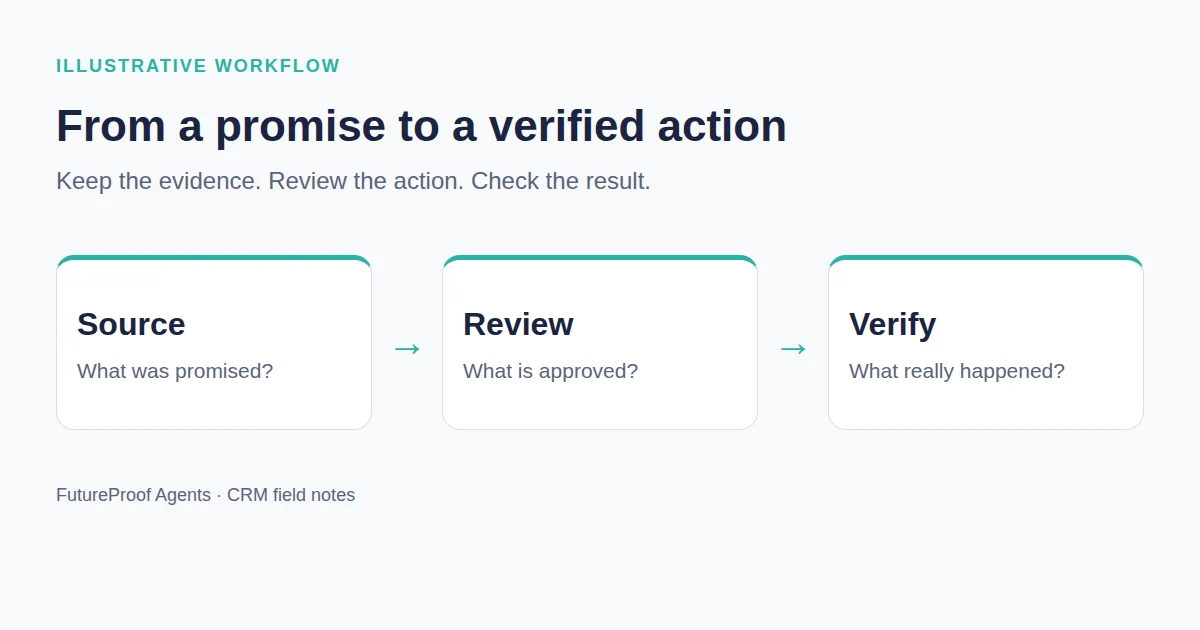
Your CRM assistant says a customer has been handled.
The operator still has to open the record, check the last conversation and find out whether anything actually happened.
That gap is the starting point for useful AI CRM follow-up automation: a traceable next action, an accountable owner and evidence of completion.
This is an illustrative workflow for a service business, informed by operational scoping discussions and public documentation.
It is not a verified customer success story, and it reports no deployed outcome, conversion lift or measured time saving.
Key takeaways
- Keep the existing CRM and its reliable reminders unless a specific limitation justifies a change.
- Separate extracting a possible task from approving and executing it.
- Link each proposed action to the relevant record and source evidence.
- Recheck changed customer context before acting on an earlier approval.
- Treat an unclear write outcome as something to reconcile, not permission to retry blindly.
- Measure review and exception handling as part of the work, not as free overhead.
The business problem behind the reminder
A service team can already have a working CRM, proposal records and follow-up reminders while its owner still acts as the memory between them.
One employee remembers what was promised on a call; another sees a newer message; the CRM holds an older next step.
The manual workflow is familiar: read the conversation, locate the correct customer, check the latest status, decide whether contact is still appropriate, write a task and confirm that someone owns it.
The difficult part is often reconciling meaning, not generating a friendly sentence.
Even a question such as “How much did we sell?” needs a definition.
Booked work, issued invoices and collected cash are different operational events, and a model should not quietly substitute one for another.
Formal revenue recognition is more specific still: IFRS 15 ties recognition to satisfying performance obligations, rather than simply counting bank receipts.
That standard is an example of why definitions matter, not a claim about which accounting rules govern your business.
For follow-up, the equivalent question is what “handled” means.
A drafted message, an assigned task and a confirmed customer response deserve different labels.
Start with what the CRM already does
Write down the current handoff before choosing another AI product.
If a structured field and a deterministic reminder can solve the problem, use them.
The Anthropic guide to building effective agents recommends starting with simple solutions and adding complexity only when it improves the task.
Use an existing CRM workflow for a clear rule such as “an approved follow-up date has passed and the task is still open.”
AI becomes a candidate when the input needs interpretation: an informal message that changes a commitment, a call note containing several possible actions or contradictory records requiring a readable comparison.
Existing components also cover review routing.
n8n documents human approval before selected tool calls, while Power Automate supports approval workflows.
These are implementation options if already suitable for your environment, not a recommendation to buy another subscription.
The design work is deciding what the person must see and which actions the integration may perform.
Build a next-action record, not another summary
The illustrative first version reads an authorized subset of CRM records and conversations, then prepares proposals for an operator.
It does not send customer messages or change commercial commitments.
Each proposal should identify:
- The existing customer and opportunity record, using stable identifiers.
- The source message or note and its timestamp, available only to authorized reviewers.
- The proposed next action, with a plain explanation of why it is needed.
- One accountable owner and a due date only when a date is supported or explicitly chosen.
- Any conflict, missing information or reason to stop.
- The current workflow state and, after execution, the destination record identifier.
A message saying “let’s talk later” should not silently become a meeting next Monday.
A customer asking to pause should override a generic “stale opportunity” reminder according to the business’s documented contact policy.
Match records before interpreting their commercial significance.
HubSpot’s deduplication documentation illustrates that matching depends on identifiers and creation paths; an integration should not assume that every API operation inherits the interface’s duplicate protection.
If two records could be the same customer, put the ambiguity in the review queue.
Do not let similarity of names become a silent merge decision.
Make approval specific, current and enforceable
The reviewer needs the proposed action, recipient or destination, relevant evidence and the exact fields that will change.
“Approve handling this customer” is too broad to be an informative decision.
In this design, approval is bound to the reviewed action and the relevant source-record version.
Before execution, the integration checks whether the customer has replied, the task was completed by a colleague, the owner changed or the proposed content was edited.
A material change invalidates that approval and sends the revised proposal back for review.
This recheck should be implemented in the workflow or destination service where possible, not entrusted to a prompt telling the model to be careful.
OWASP’s guidance on excessive agency recommends limiting functionality and permissions and enforcing authorization in downstream systems.
A read-only assistant should not inherit a general-purpose tool that can also delete records or send messages.
Keep the pilot’s scope narrow enough that its permission set is easy to explain.
Approval also needs an owner and an escalation path.
When a request expires or the reviewer is unavailable, leave the work visibly pending and route it through the agreed operational process; silence is not consent.
Verify the write and reconcile uncertain outcomes
The execution path is where a polished demonstration often stops being informative.
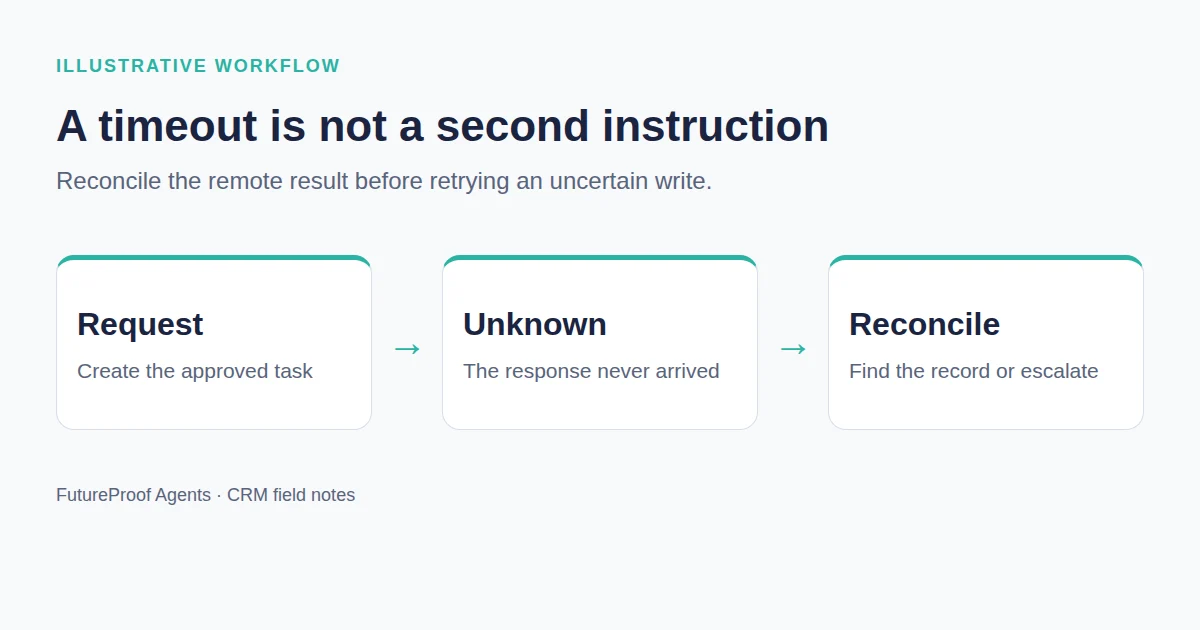
Suppose the integration requests a new task and the connection times out.
The remote CRM may have created the task even though the caller never received the response.
Blindly repeating the create operation can produce duplicate work.
The AWS Builders’ Library explanation of idempotent APIs describes using a stable request identifier so retries represent the same intended operation where the API supports that contract.
For this illustrative workflow, the operation identity includes the destination record, intended action and relevant source revision.
A local uniqueness rule can prevent two workers from claiming the same operation; PostgreSQL unique constraints are one way to enforce that locally.
That does not guarantee exactly-once behavior across an external service.
Use the destination’s supported idempotency mechanism when available, and store the returned identifier.
If the write result is unclear and the destination has no reliable reconciliation path, mark the operation “outcome unknown” and escalate instead of automatically creating again.
Read back successful writes and check the fields that matter.
For example, HubSpot’s task API supports task creation, record associations and retrieval by task ID.
The integration should confirm the intended owner, due date and association, not merely accept a model’s statement that the task was created.
A confirmed CRM write proves the record exists; it does not prove a person completed the underlying customer work.
Keep those two events separate in the interface.
Evaluate the workflow against the manual process
Begin in shadow mode: the system proposes work while the existing team remains responsible for the real workflow.
A small initial set can expose obvious mistakes, but a handful of successful examples is not a reliability estimate.
Build a broader, representative evaluation set with normal work, difficult cases and a held-out portion that was not used to tune the prompts.
Have an operator label the expected decision and supporting evidence before comparing outputs.
Include cases where the correct answer is to do nothing.
The evaluation should cover at least these failure modes:
- A customer already replied after the proposal was drafted.
- A colleague completed the task while approval was pending.
- Two possible customer records match the conversation.
- A date or owner was never specified.
- An old message is replayed or a worker restarts.
- A create request times out after the remote service may have committed it.
- A note contains instructions that should be treated as untrusted content, not permission.
Measure missed necessary tasks as well as unnecessary proposals.
Track wrong-record associations, unsupported dates, duplicate confirmed actions, unresolved outcomes and unauthorized attempts separately.
For operator effort, compare manual handling time with proposal review, corrections, exception resolution and ongoing maintenance.
An evaluation that counts only drafting speed misses the very work this system is supposed to remove.
Set acceptance and stop criteria before the trial according to the impact of each failure type.
A privacy breach or unauthorized customer message should not be averaged away by many correctly drafted reminders.
The NIST AI Risk Management Framework provides a voluntary foundation for organizing evaluation and risk management; using it does not certify this workflow.
A sensible first release
A useful first release could prepare source-linked tasks for one team, in one pipeline stage, with human review and verified CRM writes.
Keep customer messaging manual until there is a separate, justified decision to automate a specific kind of communication.
If review takes longer than doing the work manually, narrow the interpretation task or improve the underlying records before expanding access.
If exceptions have no clear owner, fix that operational gap before adding another integration.
For background on organizing the evidence that feeds an assistant, see the meeting-transcript knowledge-base guide and the organizational-brain guide.
The executive decision is whether this bounded workflow makes follow-through more dependable at an acceptable total cost.
The demonstration worth asking for is simple: show the original commitment, the approved action and the record proving what happened next.
Executive field notes
Apply to the FutureProof Agents executive newsletter for practical analysis of AI implementation and operational decisions.
Admission requires Yuval’s personal approval and email verification; submitting an application does not automatically subscribe you.
Sources
- Anthropic: Building effective agents
- n8n: Human-in-the-loop for tools
- Microsoft: Create and test an approval workflow
- HubSpot: Deduplicate records
- HubSpot: Tasks API
- OWASP: Excessive agency
- AWS: Making retries safe with idempotent APIs
- PostgreSQL: Constraints
- NIST: AI Risk Management Framework
- IFRS Foundation: IFRS 15
Thousands of builders are already inside. Questions, builds, and what actually works.
GPT-6 Astra: Everything You Need to Know (2026 Guide, Use Cases, Pricing, and How We Deploy It in Organizations)
What GPT-6 Astra is, what it costs, how computer use works, 12 real use cases with time and money, and how we deploy it inside organizations.
GPT-6 Astra: כל מה שצריך לדעת (מדריך 2026, דוגמאות אמיתיות, מחירים, ואיך אנחנו מטמיעים אותו בארגונים)
מה זה GPT-6 Astra, כמה הוא עולה, איך עובדת הפעלת המחשב, 12 דוגמאות אמיתיות עם זמן וכסף, ואיך אנחנו מטמיעים אותו בתוך ארגונים.
How to Build Games With GPT-6 Astra: A Case Study From 14 Games, One Rocket and a $250 Souls-Like
14 games built with GPT-6 Astra in one week: build times, costs, the prompts that worked, why the pretty game was not the fun one, and what still needs a human.